
The Missing Chapter in Carl Jung's Work: How to Actually Experience Active Imagination
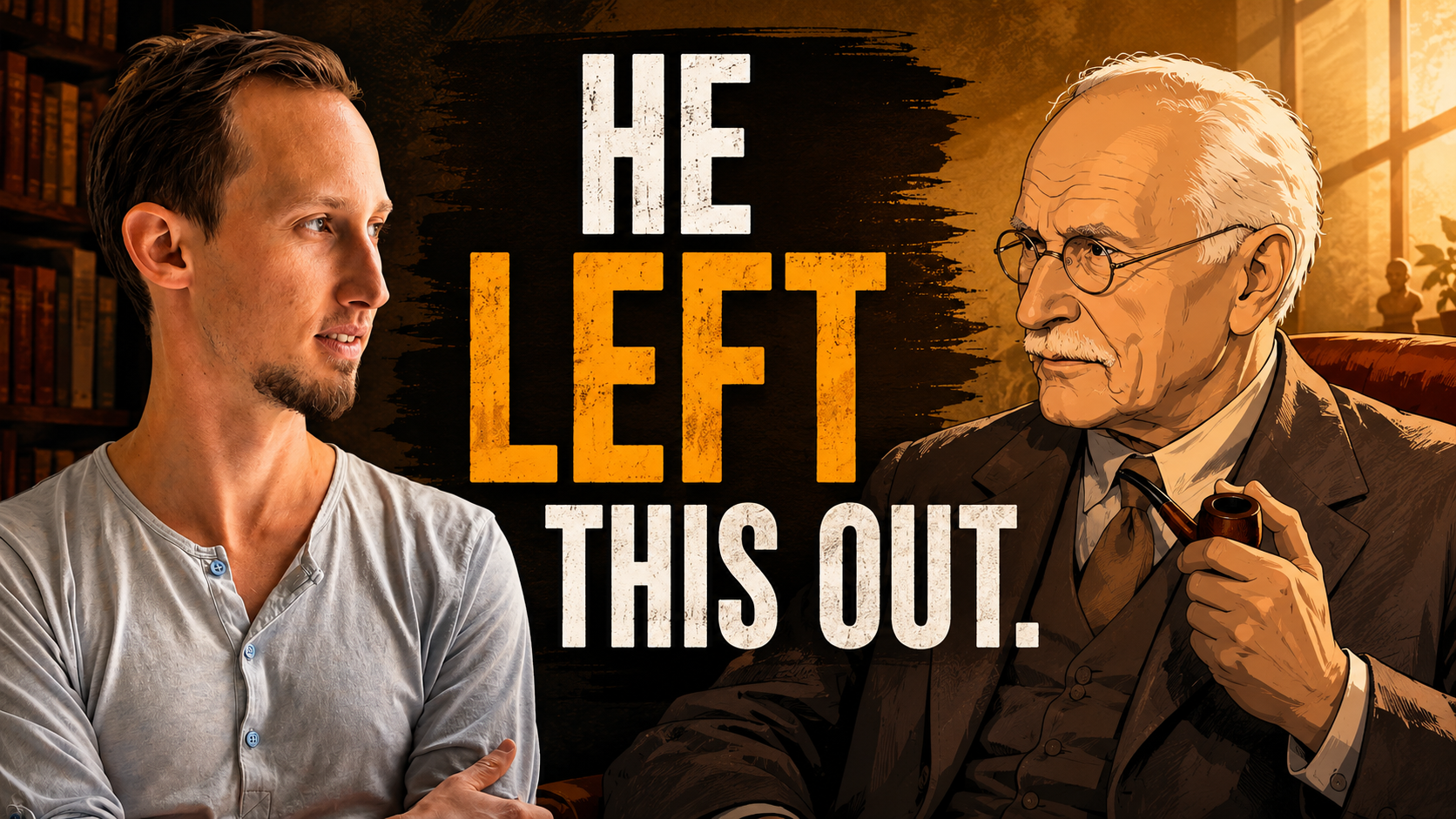
If the legendary psychiatrist Carl Jung were sitting right next to you today and you asked him, "Carl, how do you actually do shadow work? What is your personal method?" he would give you a very specific set of instructions.
He would tell you to find a quiet place in your house and recline comfortably on your sofa. He would emphasize that you shouldn't lay completely flat, or you might fall fast asleep. He'd tell you to close your eyes, take a few deep breaths, and slowly allow your body to grow heavy, settling into that twilight state right between being half awake and half asleep.
From there, Jung would instruct you to focus your attention on an ambiguous image, perhaps a striking fragment from a dream you had last night, or a persistent thought that has been occupying your mind. You would place that image out in front of your mind's eye, and then you would wait.
You would wait, and wait, and wait until your subconscious mind handed you something substantial to focus on.
Jung called this method Active Imagination. It was the foundational technique he pioneered to explore and analyze his own profound subconscious depths.
The Great Practical Hurdle of Jungian Method
While Active Imagination sounds beautiful in theory, Jung omitted a crucial reality that affects the vast majority of us who are not trained psychologists: It is incredibly difficult to do on your own.
When the average person tries to sit in a quiet room and wait for the subconscious to speak, they usually get stuck. Without specialized training, we tend to stay trapped in our everyday, normal waking consciousness.
Our ego and our physical senses remain firmly anchored to the external world. Furthermore, the ego actively acts as a defensive gatekeeper, deliberately distracting us to protect us from looking at memories or parts of ourselves that are triggering, painful, or deeply uncomfortable.
Without a tool to temporarily disarm this defense mechanism, it is nearly impossible for an untrained practitioner to drop deep enough into the psyche to meet the shadow.
Fortunately, there is a powerful, time-tested approach that flips the script and accelerates your descent into the subconscious mind.
The Subconscious Journey: Borrowing from Ancestral Tech
This alternative method is called a subconscious journey, though it has worn many different names across human history. For thousands of years, tribal cultures worldwide—from the steppes of Siberia to the communities of Africa—have utilized the exact same psychological bypass mechanism: a rapid, steady, high-BPM acoustic rhythm.
When a traditional healer, shaman, or medicine man needs to enter a deep state of trance to access hidden information, they do not sit in silent contemplation. They use the rapid, continuous striking of a drum or a rattle.
This technique is not an exclusive supernatural gift reserved for a select few; it is a predictable hack for human neurobiology.
By introducing a loud, fast, and steady drumbeat through headphones or high-quality speakers, you can experience a rapid physiological shift. Your brainwaves naturally mirror the acoustic frequency, dropping out of high-alert Beta consciousness and down into a relaxed Alpha state.
Your breathing slows, your nervous system settles, and your body grows heavy. You enter a conscious daydream state where you are asleep enough to dream, yet awake enough to actively navigate and direct your focus.
From Passive Observation to Active Prompting
The integration of a drumbeat fundamentally transforms how you interact with your inner world. Instead of passively waiting for an image to change, you can actively prompt your subconscious database.
Imagine you had a dream where a close friend was speaking to you in an alien, unrecognizable language.
Using Jung's Standard Method: You would close your eyes in silence, try to recall the friend's face, and hope your mind organically moves the scene forward. Often, your logical thoughts will simply drift toward your daily chores.
Using the Subconscious Journey Method: You put on a dedicated drumming track, close your eyes, take three long breaths, and allow your body to drop into the rhythm. Once you feel the heavy physical sensation of the Alpha state, you step forward with a clear, deliberate intention. You actively command your mind: "Show me my friend speaking this language. Show me exactly what I need to know about this symbol."
Then, you release control and let the subconscious take over.
This is where the practice becomes incredible. When you approach your mind with open-ended, intentional questions—like "What am I afraid of?", "What is the true source of this emotional trigger?", or "What is the root cause of this toxic behavioral pattern?"—the subconscious immediately begins projecting imagery.
You will often feel a distinct sense of movement, as if you are passing through portals or down long corridors until you arrive at a highly specific internal scene.
Facing the "Sticky, Icky" Reality of the Shadow
If you ask your mind deep, courageous questions about your triggers and shadow aspects, the answers will not always be comfortable. The subconscious communicates through your body just as much as it does through visual symbols.
If you carry a deeply buried fear of drowning, you might feel your throat physically tighten during the session.
If you are exploring an old aversion to a family member who harmed you in childhood, you may feel a sudden, intense knot tightening in your stomach.
A Note on Mental Safety: If you are currently taking psychiatric medication or are under professional psychological observation, it is absolutely essential to consult with your therapist before practicing deep inner work.
However, for the vast majority of people, the subconscious possesses an innate protective intelligence. It will rarely show you more than you are emotionally equipped to handle. It floats repressed memories to the surface only when you are mature enough to process, integrate, and release them.
There is no need to be anxious about a few minutes of physical discomfort during a journey. You are no longer a defenseless child; you are an adult, sitting in a safe, controlled room in your house, fully capable of witnessing your history.
A Personal Case Study: Tracing a Lifelong Trigger
To understand how profound this process can be, look at how a subconscious journey uncovers root causes that logic completely misses.
For years, I carried a crushing tightness in my chest. It would flare up out of nowhere in certain situations, acting like an overactive "danger radar." My body would tell me that my environment was profoundly unsafe and that I needed to run away immediately, even when my logical mind knew there was no immediate threat. I couldn't rationalize it away.
During a deep subconscious journey, I focused entirely on that physical tightness and asked my mind to show me the root cause.
The journey bypassed my adult logic and pulled up a highly symbolic environment: a complex, ancient maze resembling the Minotaur's labyrinth from Greek mythology. Deep inside the center of this dark maze, I saw an image of myself lying dead on top of a stone sarcophagus, watched over by a massive skeleton.
When I looked at that symbol and asked my mind, "Why am I fearing my own death? What is this skeleton representing?", my subconscious instantly unlocked a flood of pristine, vivid memories from when I was five years old.
I was a small child during the 1990 Gulf War, living in a city targeted heavily by missile strikes. We didn't have a modern bomb shelter. Because of widespread fears regarding chemical weapons, we had to wear suffocating rubber gas masks whenever the air-raid sirens wailed in the dead of night.
One night, fearing our roof might collapse from a blast, my parents decided our safest option was to sit inside our heavy wooden clothes closet. The closet had strict vertical dividers that could only fit one person per section.
My mother and infant brother sat in one slot, and I was placed in the dark slot right next to them. My father had drilled a small hole through the wood partition so my mom and I could tightly hold hands in the dark, but the closet doors had to remain completely shut to protect our faces from potential flying glass and debris.
As a five-year-old boy, sitting trapped in pitch darkness, breathing through a rubber gas mask, holding a hand through a hole, and listening to explosions outside, I was utterly terrified for my life. I was completely immobilized, unable to run away, forced to sit perfectly still and wait out a mortal threat.
Even though I am now nearly 40 years old, that raw, cellular memory was still perfectly alive inside my chest. My adult mind had categorized it as an old historical event, but my subconscious was still running the childhood survival script every time an everyday situation felt vaguely unsafe.
Seeing that root cause changed everything. By witnessing the memory through the journey, I was finally able to connect the physical tightness to the little boy in the closet. Now, whenever that danger radar flashes, I can take a deep breath, regulate my nervous system, and gently remind my inner child: "We are safe. The war is over. We are adults now, and we are completely out of the closet." The tightness has steadily released its grip ever since.
Step Into Your Own Database
Your shadow holds the exact blueprints to your current anxieties, self-doubt, relationship patterns, and irrational fears. It is an incredibly rich archive waiting to be explored, processed, and integrated into your personal growth.
If you are ready to move past shallow surface-level journaling and experience an authentic subconscious descent, I have provided a complete Guided Subconscious Shadow Journey.
To get the most out of your session:
Prepare Your Space: Find a quiet, undisturbed room where you can have 15 to 20 minutes entirely to yourself.
Position Your Body: Sit in a comfortable, reclined position (remember, do not lie flat to avoid falling into a standard sleep cycle).
Use Audio Gear: Put on a pair of high-quality headphones so you can fully feel the resonance of the drumbeat.
Cross the Threshold: Close your eyes, take three long, deep breaths, focus on your chosen trigger or question, and allow the rhythm to carry you downward.
Let's go on the journey.