
How to Access Your Subconscious Mind with Subconscious Journeying
If you can daydream, you can do this too.
We all have the natural ability to dream, to enter our subconscious mind. We do it automatically every night, even when we don’t intend to. And we also do it during the day — when we drift into daydreaming, receive sudden insights, remember hidden memories, or experience gut feelings that suddenly make complete sense.
You know those moments when something clicks and you think: Wow… this is true.
By the end of this article, you’ll understand how to practice subconscious journeying yourself, and I’ll also share my four biggest tips for succeeding with it.
What Is Subconscious Journeying?
Dreaming and subconscious journeying are very similar to daydreams or nighttime dreams.
You are the main character inside your own inner world. You navigate through it toward whatever intention, question, or direction you want to explore.
The key is that you enter the journey with a question.
That question can be very practical:
What should I do with my relationship?
Should I stay in my current job or pursue my dream?
Should I relocate to another country or city?
Should I accept this opportunity?
Or it can be deeply personal:
What do I need to work on within myself in order to evolve?
What is actually blocking my path?
What is my next challenge to overcome?
« Watch the beginner’s video guide, guided journey and drum track to practice at home »
Don’t Ask Yes-or-No Questions
Yes-or-no questions belong to the rational mind.
They belong to waking consciousness, the logical, analytical state we use every day. But the subconscious mind doesn’t communicate in such rigid terms.
The subconscious is fluid. Symbolic. Elusive.
Everything inside it can hold multiple meanings at once.
Instead of receiving a simple “yes” or “no,” you usually receive a feeling.
Your body becomes the answer.
If something is aligned for you, your body tends to expand. You feel relaxed, safe, warm, loved, appreciated, and at ease.
That sensation is usually a “yes.”
But when something feels contracted, cold, fearful, closed, or heavy, your body is signaling a “no.”
And this is extremely important:
During subconscious journeying, you don’t only see images or hear words like in a normal dream. Your body participates in the experience with you.
Your body becomes the anchor that helps you understand whether:
something is genuinely good for you,
you are simply conditioned to fear it,
your ego is suppressing your growth,
or your subconscious is actually warning you to stop.
How to Practice Subconscious Journeying
The process itself is very simple.
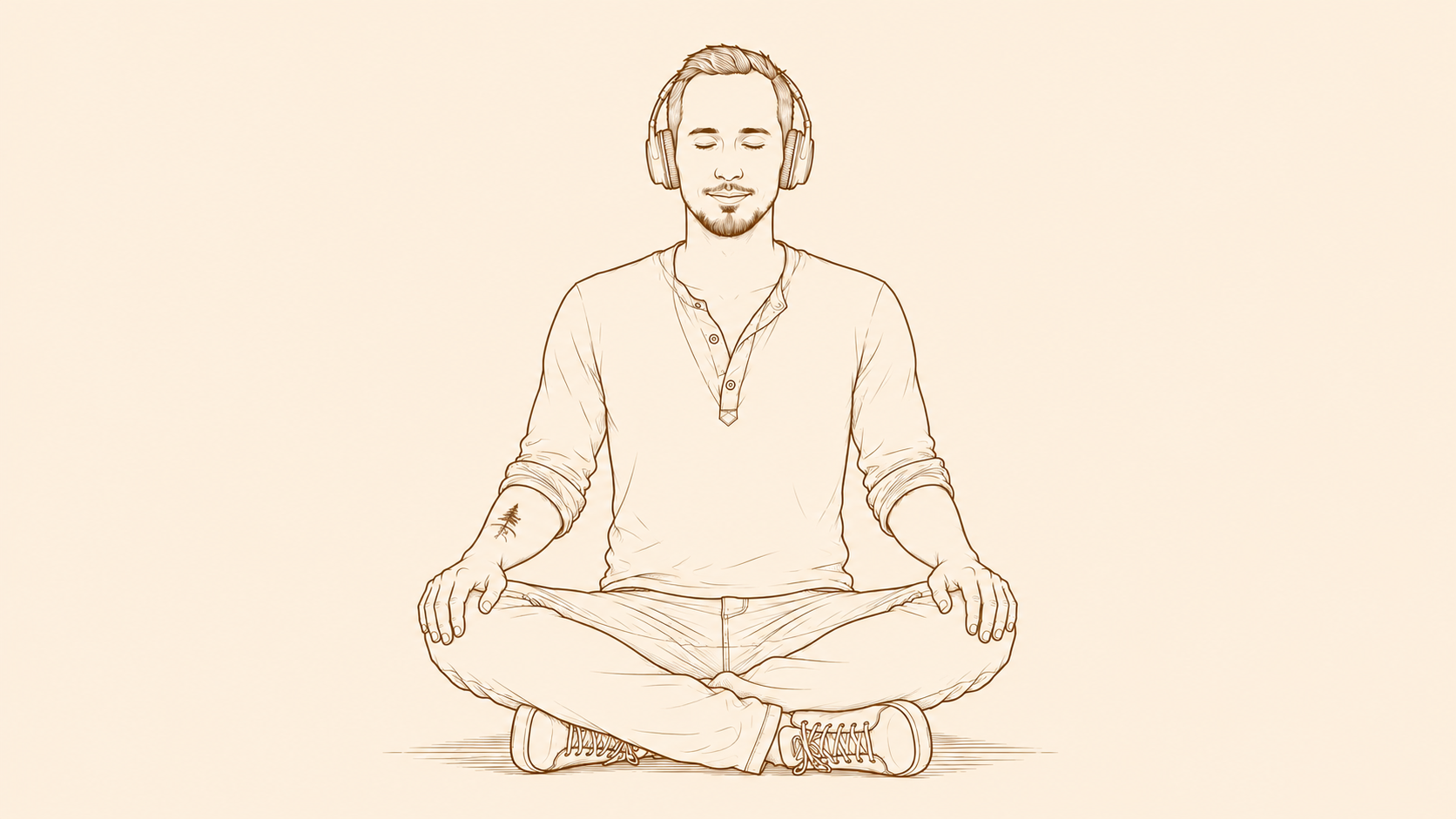
Find a comfortable place in your home. You can lie on a bed, sit on a sofa, sit upright, or completely lie down, whatever feels natural and safe for you.
Then put on your headphones and begin listening to a repetitive drum track.
The repetitive rhythm is important because it gradually shifts your brain from active waking beta waves into slower alpha waves.
As your brain slows down:
your analytical mind relaxes,
judgment quiets,
thinking becomes softer,
and you begin entering a semi-trance state.
It feels similar to a daydream.
You are still here, aware of your body and your surroundings, but another part of you begins journeying somewhere deeper inside your subconscious.
Next:
Close your eyes and take three long, slow breaths through your nose.
Inhale deeply.
Exhale slowly.
Do this three times.
Usually, your body begins relaxing naturally. You may feel heavier, almost like entering the state right before sleep; a kind of self-hypnotic state where you feel safe enough to let go.
Then imagine yourself entering another place.
Open your “inner eyes.”
Suddenly, you are in a different setting — like entering a dream.
Now ask your question:
Show me what I should do.
Show me what would happen if I choose option A over option B.
Show me what I need to focus on in the next five years.
Show me what is blocking my growth.
Your intention becomes the direction of the journey.
Let the Journey Lead
Once you ask the question, control should begin to relax.
This is very important.
Like a dream, you don’t force the experience. You allow it to emerge.
Think of it almost like prompting an AI.
You give your subconscious a prompt:
Should I leave my job?
Then your subconscious begins processing that prompt.
It starts showing you things.
The challenge here is staying focused and clear-headed.
You need to temporarily release:
your chores,
your worries,
your plans,
future responsibilities,
and thoughts from the past.
Clear your mind and simply observe what your subconscious presents to you.
Then follow it.
What If You Doubt Yourself?
This is completely normal.
If you lose focus or become distracted, you can always “rewind” the experience mentally and ask again.
Ask for clarification.
If something doesn’t feel right, ask again.
If you think you’re making everything up, ask again.
Usually, true subconscious messages feel different.
They are clearer.
More vivid.
You feel them strongly in your body.
You simply know.
But whenever skepticism becomes dominant, it often means you have shifted back into the rational mind rather than remaining deep inside the subconscious.
At that point, the answers may come more from:
ego,
wishful thinking,
fear,
or over-analysis,
instead of the actual journey itself.
Learning how to trust intuition is another important topic that deserves its own deeper discussion.
The Four Biggest Tips for Success:
1. Practice Regularly
This takes practice.
Most people don’t master it on the first attempt.
But almost everyone can eventually succeed because we all possess imagination, intuition, and the ability to enter subconscious states.
Usually within the first few attempts, people begin experiencing genuine journeying.
So don’t try it once and immediately conclude that it “doesn’t work.”
Try at least ten times.
Experiment with:
asking different questions,
relaxing more deeply,
clearing your mind better,
and becoming more open to receiving.
2. Be Open
Your subconscious gives you what you need, not always what you want.
Sometimes the answer may surprise you.
Sometimes you may not immediately understand how the symbols relate to your question.
But usually they do.
Your subconscious responds directly to the intention you set.
Be open enough to receive answers you may not like.
That’s part of growth.
3. Stay Curious
Curiosity is essential.
You need to become genuinely interested in what might appear during the journey.
You may encounter:
forgotten memories,
unexpected symbols,
surprising emotions,
or entirely new perspectives.
The more curious and non-judgmental you become, the more your subconscious opens up.
And the more symbolism and deeper connections you begin to understand.
4. Be Patient
The subconscious doesn’t always respond instantly.
Sometimes it needs time to dig deeper.
It may retrieve memories or emotional patterns from very early in life; even from childhood.
Then it translates them into symbols and experiences that your adult mind can understand today.
Often you’ll uncover one layer and think:
Maybe there’s something deeper here.
And usually there is.
You keep digging.
Questioning.
Following.
Exploring.
Layer after layer.
Until eventually you arrive at something that feels undeniably true in your body.
And when that happens, you know.
Final Thoughts
Subconscious journeying is not about escaping reality.
It’s about accessing deeper layers of yourself that already exist beneath everyday thinking.
The more you practice:
the clearer your intuition becomes,
the more connected you feel to yourself,
and the more guidance you begin receiving from within.
So keep practicing.
Be open.
Be curious.
Be patient.
And most importantly, allow the journey to unfold naturally.